






Google Enters the Portal Wars

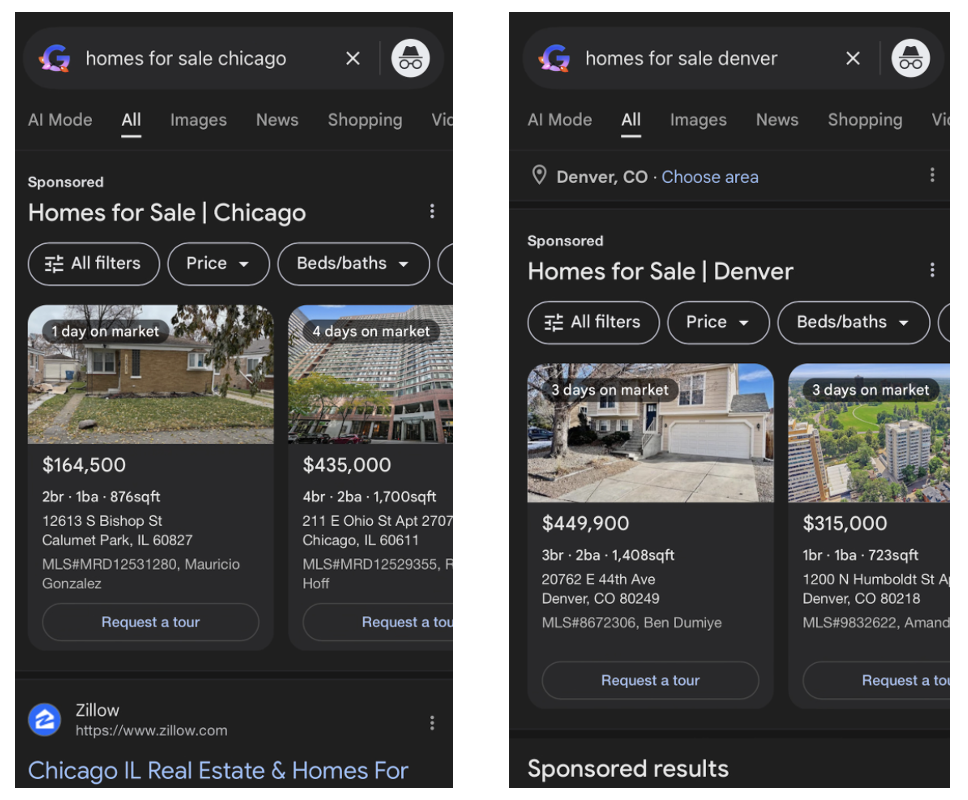
Sometimes a picture is worth a thousand words, and I think this might be one of those times.

Why it matters: Google putting for sale listings directly into search results — even if it's a test — is a big deal.

  • The functionality includes full property detail pages, links to request a tour, and contact an agent — you know, the core business model of real estate portals.
     

  • This appears to be a test, live in a limited number of markets and only on mobile.

It appears this is a partnership with ComeHome by HouseCanary, and property results are "not supplied or sponsored by listing agents or brokers."


The bottom line: There are a lot of potential implications here, from the incumbent portals to exclusive listings to AI and international, but for now it's all speculation.

  • Let's wait and see how this plays out.
     

  • If you thought 2025 was interesting, 2026 is shaping up to be a zinger!

Logical Fallacies, Seller Motives, and Private Exclusives


During last week’s Compass v. Zillow court hearing, surveys and research were presented to support each side’s position on the relative merits of exclusive listings versus broad exposure.

Why it matters: Evidence can be presented in such a way to tell whatever story you want – and in this case, digging deeper shows that the data and associated conclusions are not as straightforward as each side would have you believe.

Dig in: During the hearing, a Zillow consumer survey on private listing networks was shown as evidence, and despite the intended result, raised more questions than it answered – especially when you consider the inverse of the results.

  • For instance: 52 percent of respondents said one of the most important factors when choosing an agent is that agent’s ability to get their home in front of the largest pool of interested buyers – meaning that broad exposure was not among the most important factors for 48 percent of people.
     

  • In the same survey, 45 percent of respondents said one of the most important factors was the promise of getting the highest sale price – with the inverse suggesting that 55 percent of people did not consider getting the best price as one of the most important factors when choosing an agent.
     

  • Even though the question is about choosing an agent, the results suggest a diverse range of seller motivations.


The survey results were equally enlightening on the topic of private listing networks: on the same question, 21 percent of respondents said one of the most important factors is access to an exclusive buyer network.

  • And on a different question, respondents said if they were selling a home, 39 percent would prefer to have it listed on a consumer real estate website, while 31 percent would prefer to have it listed on a private listing network.
     

  • The survey results reveal a significant population of sellers that prefer listing on a private listing network for a period of time – and notably, 21–31 percent is in the same ballpark as the percentage of Compass exclusive listings: around 24 percent.


The debate around private exclusives often includes research showing the efficacy of listing off-market vs. on-MLS.

  • Unsurprisingly, each side has released research – with similar underlying datasets – to numerically support their position.
     

  • It’s like I say in my presentation, Propaganda: you can manipulate data to tell whatever story you want.


Oft-quoted research from Bright MLS showed that homes listed on an MLS sell for 17.5 percent more than homes that are sold off-MLS.

  • The logical fallacy here is that correlation does not equal causation: the study treats the observed premium as an effect caused by MLS exposure rather than from any underlying differences between homes.
     

  • For example: the off-MLS data includes for sale by owner (FSBO) listings, which, according to NAR, have a median sales price 18 percent lower than agent-assisted sales – in part because they “tend to be more frequently lower-cost mobile homes or those located in rural areas.”
     

  • If we already know FSBOs sell for less, putting them in the off-MLS group and then “discovering” that off-MLS sells for less is circular — the conclusion is already baked into the grouping.
     

  • Similar research from Zillow helpfully excludes FSBO from its off-MLS dataset and found a sale price difference of 1.5 percent, and more recent research from Bright MLS focused on office exclusives (not FSBO) and found that “whether or not a home was pre-marketed as an office exclusive has no impact on the close price.”


Similar research from Compass shows pre-marketed listings were associated with 2.9 percent higher sales prices.

  • Same problem: the homes that are pre-marketed may be systematically different (price point, marketability, price- and time-sensitivity).
     

  • The key point is that pre-marketed listings are not random; Compass’s research simply shows that the types of homes that opted for pre-marketing sell for slightly more, not that pre-marketing a home makes it more valuable.

The competing research all makes the same logical leap: looking at two very different, self-selected groups and claiming the only meaningful difference is pre-marketing or the MLS.

  • The correlation ≠ causation fallacy confuses the path chosen with what that path actually does – in the same way that flying business class doesn’t make you richer, ticking the “MLS” or “pre-marketing” box doesn’t automatically add 17% or 3% to the sales price.
     

  • It is worth noting that once we exclude FSBO, the research from Zillow, Compass, and Bright MLS all present similar results: -1.5%, +2.9%, and no price difference at all – seemingly within a practical, economic, and methodological margin of error for real-world home prices.


The bottom line: There’s a lot of data out there and it’s not telling a straightforward story.

  • To really answer the question of where a home will sell for more, we would need quantum real estate: the ability to sell the same home across an infinite number of parallel universes to see which factors yield the highest sales price.
     

  • The evidence does suggest that homesellers’ motivations are more varied than most assume, and “exposure is everything” is not universally true.
     

  • In the end, any claims about which path “sells for more” or what’s “best for consumers” are oversimplifications of a far more dynamic and surprising reality.

Zillow's Listing Ban and Violation Metrics


Zillow began enforcing its new listing access standards in July of this year, the lynchpin of its strategy to fight back against private listings, and last week’s courtroom hearing revealed new metrics on the number of listing violations and bans.

Why it matters: These metrics are evidence of how aggressively Zillow is enforcing its listing policy.

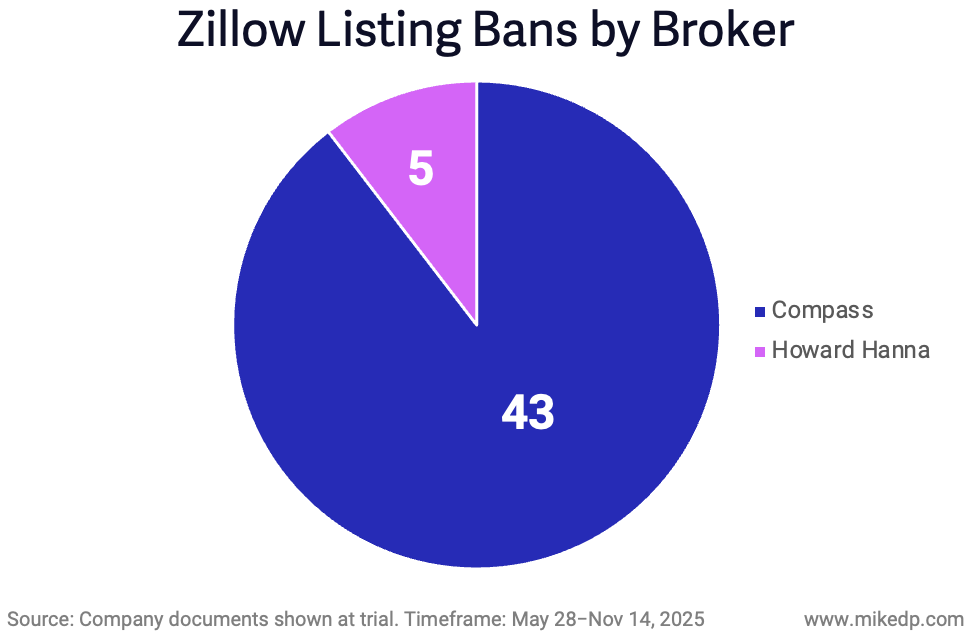
  • The data reveals that, through November 14th, Zillow has banned a total of 48 listings nationally.


Zillow banned its first listing in July of 2025.

  • Data for August and September wasn’t revealed, but by October 15th, Zillow had banned 28 listings before nearly doubling that number by November 14th. 

The vast majority of these listing bans, about 90 percent, were Compass listings.

  • The remaining 10 percent were Howard Hanna listings, another brokerage that appears loosely aligned with Compass’s strategy and has a private listing network of its own.
     

  • As of November 14th, these are the only two brokerages with listings banned from Zillow – which roughly correlates to the amount of effort different brokerages are putting into their private listing programs.


Before a listing is banned, an agent receives a series of violation notices.

  • According to the documents reviewed in court, as of November 14th Zillow had sent out a total of 1,202 listing violations to 24 different brokerages.
     

  • The brokerages receiving at least two violation notices are listed below.


Compass agents are the recipients of the vast majority of these notices, accounting for 1,137 or 95 percent of all notices.

  • Zillow’s internal strategy documents repeatedly mention Compass and “other bad actors,” but there was no evidence that Compass agents were specifically targeted.


Zillow appears to be primarily enforcing its policy in the mid-Atlantic: Washington, D.C., Maryland, Virginia, and Pennsylvania.

  • Over the past month, there have been bans in a handful of other states, including Texas and Florida, as the policy starts a slow, national rollout.


I conducted a survey in the days before publishing this article, asking my LinkedIn followers how many listings they thought Zillow had banned nationally as of November 14th.

  • Based on the results, many people will be surprised at how few listings have been banned: 80 percent of the 870 respondents thought Zillow had banned more than 50 listings, with 49 percent guessing that Zillow had banned over 1,000 listings.


The bottom line: Zillow probably wants the number of banned listings to be as small as possible.

  • A critical part of Zillow’s listing standards is the threat of a ban on Zillow, designed to put immense pressure on agents and homesellers to change behavior – ideally without an actual ban.
     

  • It’s a tricky needle to thread: because a banned listing effectively punishes a homeseller, Zillow needs to carefully calibrate its enforcement to maximize its business goals while minimizing collateral damage against consumers.

A Strategic Analysis of the Compass v. Zillow Court Hearing


Robert Reffkin, CEO of Compass. Courtroom sketch courtesy of Elizabeth Williams, used with permission.


Last week I attended the best industry event I’ve ever been to. Over a dozen executives from Zillow and Compass were “on stage” for three days, discussing private exclusives, home search competition, highlighting evidence, and revealing their internal strategic planning processes – all under oath and subject to cross-examination.

Why it matters: The Compass v. Zillow preliminary injunction hearing in federal court provided a valuable foundation to look at one of the most important power moves occurring in real estate: the battle over exclusive inventory.

The big takeaway: I’ll revisit this at the end, but regardless of this court case’s outcome, I don’t believe anything will change.

  • Throughout the past 12 months of passive and active opposition to Compass’s strategy, nothing has materially suppressed adoption of its exclusive inventory program.
     

  • Plus, there is so much grey area in real estate, I believe that if Compass, agents, or homesellers want to continue this practice (as they’ve done for decades), they’ll find a way.
     

  • The hype tends to outrun the reality with these things: remember how the commission lawsuits and NAR’s revised clear cooperation policy were going to “change everything?”

The court hearing and associated evidence made it clear that behind the pro-consumer positions, there were clear business motivations driving both company’s decisions and strategies.

  • Zillow saw the rise of private listing networks, led by Compass, as a threat and explored a variety of “hardline tactics” to induce agents and brokerages to continue putting listings into the MLS and, therefore, Zillow.
     

  • Compass was clear that its strategy is about competitive differentiation, giving their agents an advantage in the market, and if it's good for its agents, it's good for Compass.


Jeremy Wacksman, CEO of Zillow. Courtroom sketch courtesy of Elizabeth Williams, used with permission.


A number of subjective “soft” factors, and the importance they’ll play in this battle, emerged during the hearing.

  • Again, this is purely subjective based on texts, emails, and group documents – which all reveal insights into each company’s decision-making process – but it appears that Compass is acting with more agility and speed.
     

  • Compass also benefits from its offensive focus: it is dictating the course of events and maintaining the initiative, while Zillow is responding to events outside of its control.
     

  • Finally, and perhaps most importantly, comes communication: Compass’s core argument requires less cognitive load to understand due to its simplicity.
     

  • Zillow’s argument doesn’t have the same coherence nor simplicity: We’re against hidden listings. But if a listing is fully hidden, we’re ok with that. If it’s kind of hidden, we’re not OK with that, and as punishment we’re going to hide it from our site, too.
     

  • An example of a simple, positive, and powerful message for Zillow would be this TV commercial that Australia’s leading portal published in 2020.


When considering the strategic implications of the trial and the relative positioning of each company, it’s important to look at the time factor: is each company’s position getting stronger or weaker over time?

  • Compass only gets stronger, primarily with the proposed Anywhere merger, giving it massive scale.
     

  • Zillow currently faces mounting legal pressure from a number of different lawsuits – all of which will consume time and money (and distract its executives).
     

  • Additionally, there appears to be a growing trend of MLSs setting their own rules around listings, as evidenced in court by the rising number of MLSs that allow coming soon listings of greater than 24 hours (in violation of Zillow's listing standards).


For my overseas audience, I want to take a moment to talk about the international implications of this battle.

  • Temporarily withholding inventory from the #1 portal is a growing trend in markets like Sweden and the U.K., largely a result of a decade of hefty price increases.
     

  • To date, it’s not clear that Zillow’s actions have been effective: Compass still has over 8,000 exclusive listings.
     

  • A more effective strategy for a #1 portal may be less punitive and focused on business partnerships: helping agents differentiate and grow (Zillow already has this product).


Having sat through several days in court, it’s clear that there remains plenty of common ground between Compass and Zillow.

  • Both parties agree that, in general, Compass is focused on agents and Zillow is focused on consumers – a complimentary mix.
     

  • Neither party really wants to hide listings; Compass is searching for an advantage that lets it differentiate while providing more value to its customers, and Zillow just wants to display all inventory for sale.
     

  • Earlier this year, both companies engaged in high-level negotiations around a potential partnership, and litigation aside, that opportunity remains.

The big takeaway: Regardless of the outcome of this trial, I’m not sure anything changes.

  • Consider that between the date Zillow announced its new policy and the start of the hearing, the number of Compass private exclusive listings, total listings, and agents are all up.
     

  • But the number of Coming Soon listings and the overall percentage of listings that are "exclusive" are down, but this may be seasonal – the point is that the total number of exclusive listings is still above 8,000.
     

  • This is important because Zillow’s policy wasn’t about containment, it was about elimination of private listing networks, and despite its best efforts over seven months, Compass’s network is as strong as ever.


The bottom line: This hearing was the culmination of a process that has likely consumed millions of dollars and many hundreds (or thousands) of hours spent interviewing witnesses, going through evidence, and compiling thoughtful arguments.

  • It revealed an unprecedented look inside each company’s strategy for one of the biggest power moves in real estate, one that will shape the landscape for years to come.
     

  • And while the hearing revealed a great deal, the outcome may not matter in the slightest – it’s what’s happening outside of the courtroom that will determine the future of the industry.

Zillow, CoStar, and the Battle over Rentals


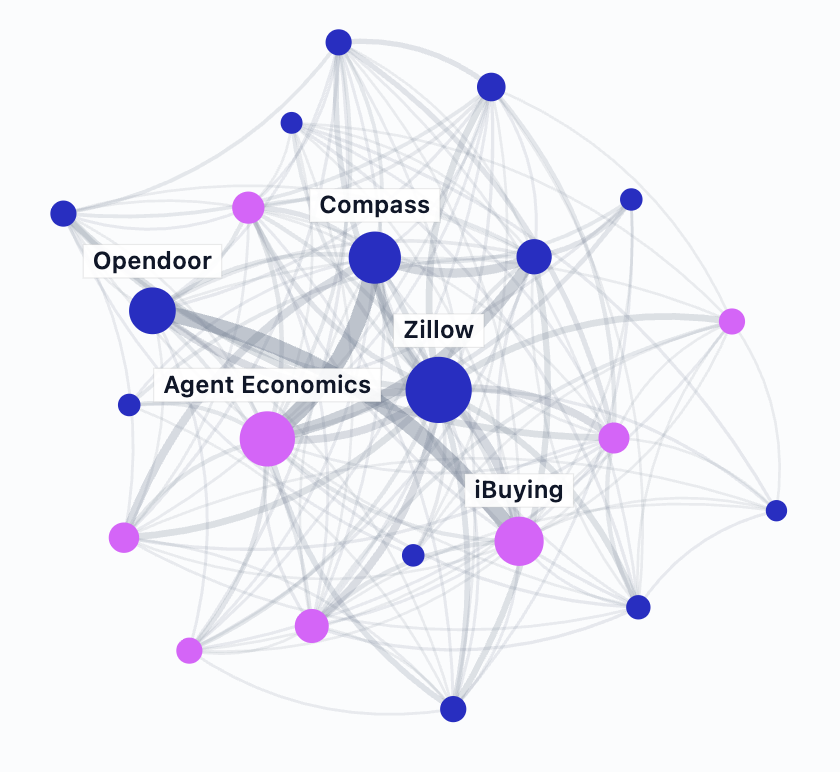
When the FTC sued Zillow over its rentals deal with Redfin, it caught many by surprise (except CoStar) – but it’s just the latest move in the Portal Wars' other battle: rentals.

Why it matters: While CoStar has made a tremendous amount of noise coming after Zillow and others, Zillow has quietly encroached on CoStar’s territory with its growing multifamily rentals business.

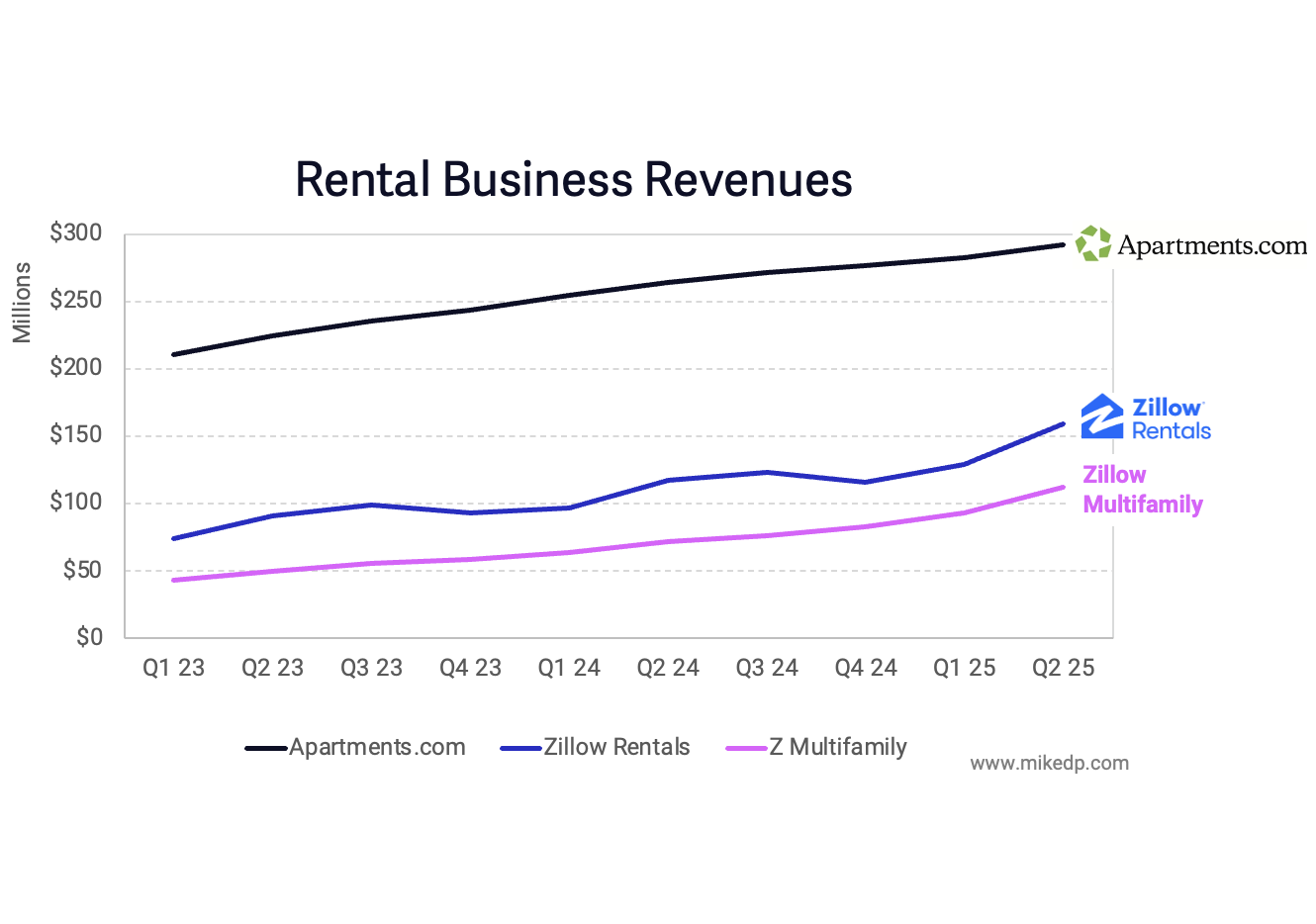
Rentals are a significant part of each company’s business: CoStar’s Apartments.com generated over $1 billion in revenue in 2024.

  • In the first half of 2025, Zillow’s multifamily rentals business generated about $200 million in revenue, accounting for 16 percent of total company revenue.
     

  • Meanwhile, Apartments.com generated over $570 million, acccounting for 38 percent of total company revenue – a significant and important business line.


Both businesses have grown considerably over the past two years. 

  • Apartments.com is the category leader in terms of revenue, but Zillow’s multifamily business is making significant gains (especially in the past year).
     

  • Note: Zillow’s multifamily business is just one segment of its overall Rentals business. I’ve reverse engineered public numbers to arrive at an estimated revenue breakdown.


Apartments.com’s revenue lead over Zillow’s multifamily rentals business has dropped from nearly 5x to 2.6x over the past two years – reflecting the significant gains made by Zillow.


The businesses are growing at markedly different rates, as measured sequentially (from one quarter to the next).

  • On a percentage basis, Zillow’s multifamily business is outpacing Apartments.com, but it’s growing from a smaller base.
     

  • Apartments.com’s growth has slowed over the past year, a fact that CoStar attributes to “pivoting the Apartments.com sales force to support the Homes.com product launch in 2024.”


Looking at growth in absolute dollar terms shows a similar story.

  • Apartments.com’s growth has slowed (but with a recent uptick), while Zillow’s multifamily growth has rapidly accelerated in the past year.
     

  • And in the last quarter, Zillow's multifamily business grew revenue $19 million compared to Apartments.com's $10 million.


It would be easy to claim that Zillow’s growing multifamily business is negatively affecting Apartments.com.

  • And while it may be having a mild competitive impact, the truth is that like portal traffic, multifamily rental revenue appears to be primarily a non-zero-sum game – both companies are growing.
     

  • Total category revenue in just one quarter has jumped from $254 million in Q1 2023 to $405 million in Q2 2025.


The bottom line: The battle over rentals isn’t getting the same coverage as the portal wars, but that doesn’t mean it’s any less significant.

  • With the FTC suing Zillow to unwind its rental deal with Redfin (something CoStar speculated about back in February), and CoStar suing Zillow over multifamily photo copyright infringement, the long-simmering battle has finally ignited.
     

  • I’m sure CoStar isn’t cheering Zillow’s encroachment on its home turf, but aside from getting distracted by Homes.com, there’s yet to be a noticeable impact on its rentals business – but that doesn’t mean CoStar won’t fiercely defend it.

Content is King: The Compass and Anywhere Deal


Compass announced it was acquiring Anywhere Real Estate, creating a behemoth with 210,000 agents and close to 20 percent market share in the U.S.

Why it matters: The obvious play is consolidation, but the power move is leverage to further Compass’s strategic aims with exclusive inventory.

  • Content is King: this deal gives Compass control over a massive amount of inventory, and fuels its push against Zillow, NAR, and the MLSs.


The best way to unpack the strategic significance of this deal is through Robert Reffkin’s (Compass CEO) own words.

  • Compass is a very disciplined corporate communicator, and Mr. Reffkin’s social media posts reflect the talking points and strategic direction of the company.
     

  • The most obvious benefit of exclusive inventory is driving homebuyers to Compass agents for access to inventory they can’t find anywhere else.


Mr. Reffkin believes agents – all real estate agents – are being exploited, with money flowing out of their pockets to the real estate portals, NAR, and MLSs.

  • The counter-argument is that the only reason Compass is doing this is to enrich itself and its shareholders; there is a clear financial incentive for this push.
     

  • Well, I've got news for you: every company involved has a financial incentive.

In the battle over exclusive inventory, Zillow, NAR, and MLSs stand in the way (some more effectively than others). 

  • Compass wants its customers – homesellers – to have the choice to advertise their properties however they see fit.
     

  • From Compass’s perspective, its fight against the industry is about control vs. choice – and this is what the leader of the combined entity believes.

The bottom line: There are plenty of corporate synergies in this deal, but, like Disney acquiring the Star Wars and Marvel franchises, the real strategic play is about content.

  • Controlling more content gives Compass more power in its fight with the existing industry hegemony.
     

  • This deal will shake up power dynamics in a way not seen in over a decade, and will shape the industry and corporate strategy for many years to come.

Compass’s Exclusive Inventory Finally Drops


A funny thing happened two weeks ago: after I published an analysis on Compass’s exclusive inventory rising despite Zillow’s efforts to stop it, it suddenly reversed course and started dropping – a lot.

Why it matters: The battle over exclusive inventory isn’t just about lawsuits, corporate posturing, and brute force – it’s also about perception.

  • And for Compass to prevail in its lawsuit against Zillow, it needs to show harm – and exclusive inventory going up, which my analysis showed, is the opposite of that.


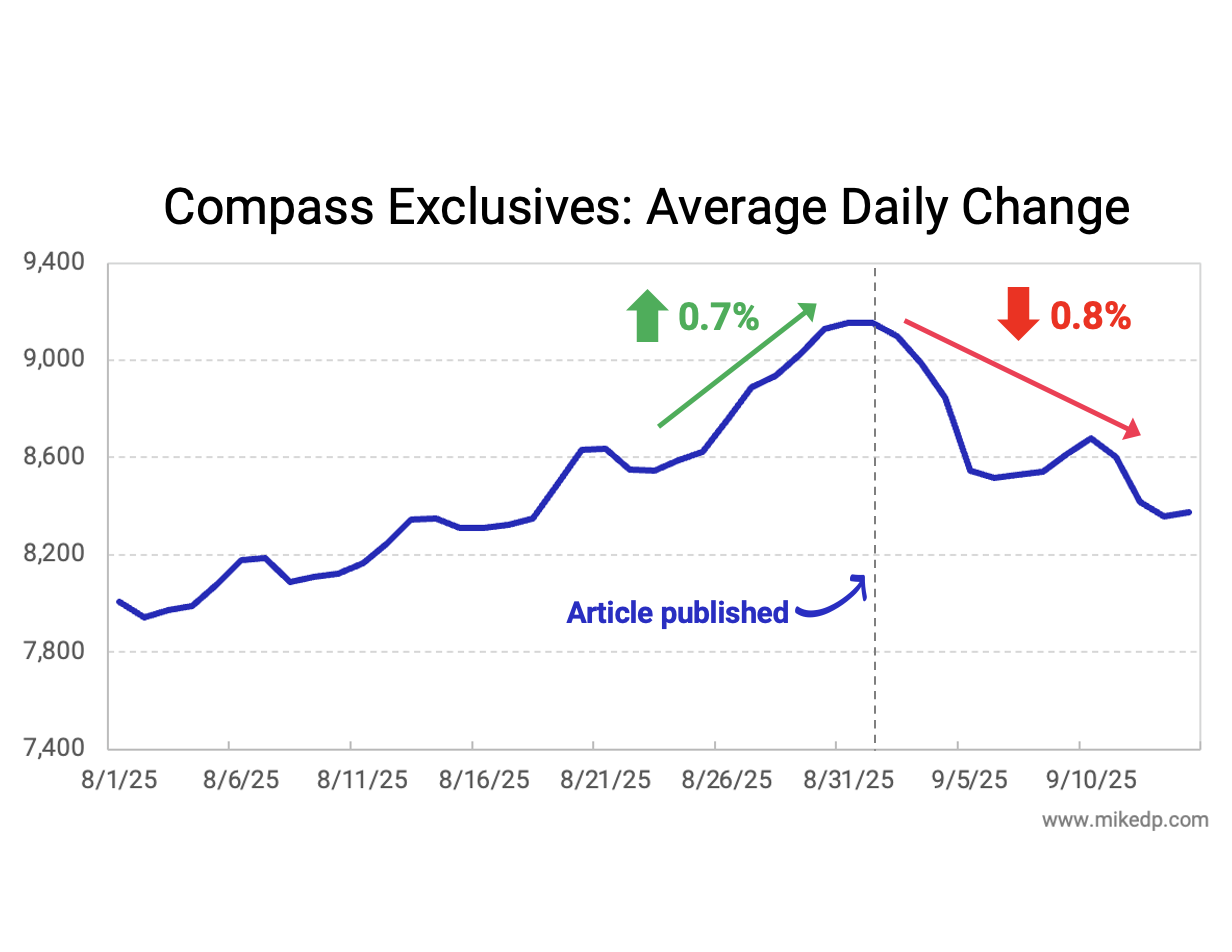
For the ten days before I published my analysis, the number of Compass exclusive listings was rising an average of 0.7 percent per day.

  • After publishing, that metric rapidly swung to an average drop of 0.8 percent per day – a full 1.5 percent change – the largest observable swing since I began tracking this data in July 2024.


During the same period, the total number of Compass listings continued to increase while private exclusives and coming soon listings dropped.

  • Meaning exclusive inventory as a percentage of total listings dropped from a high of 26 percent down to 22 percent.


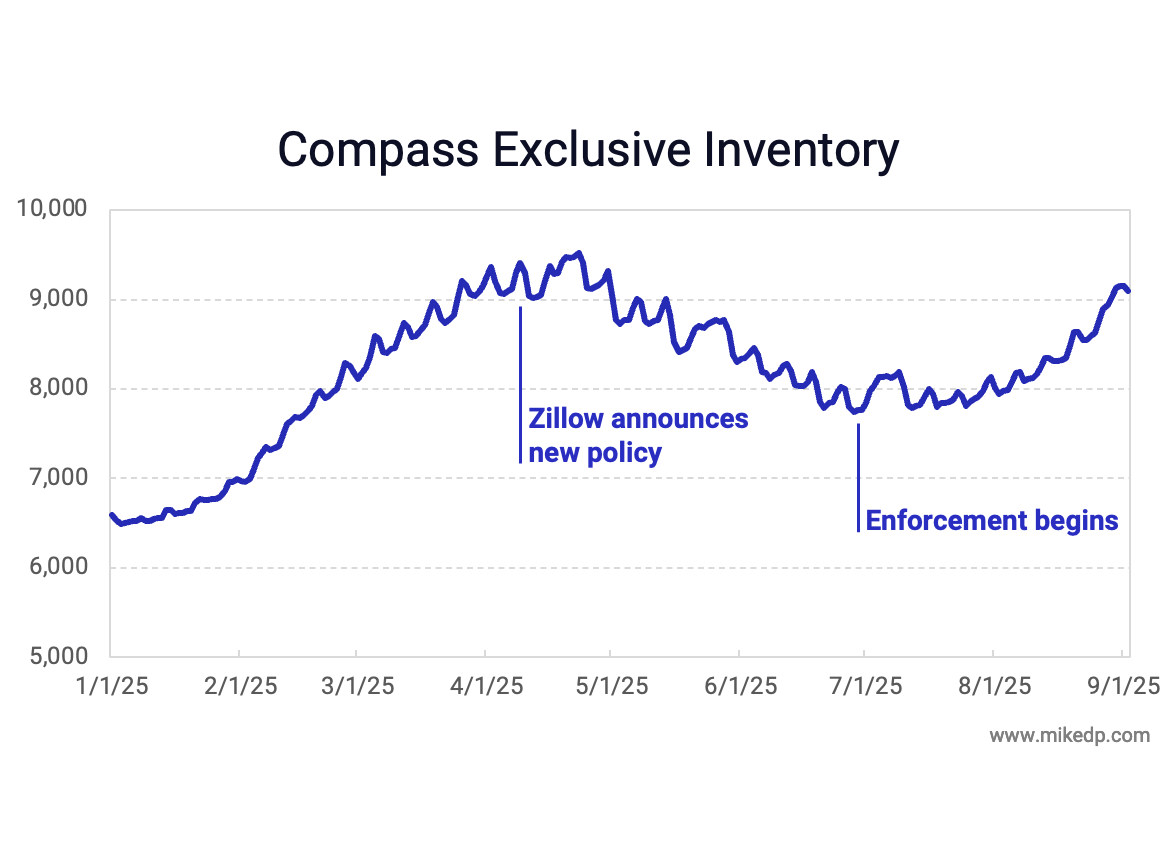
Zillow has been trying to clamp down on the rise of exclusive inventory since it announced its new listing policy in April.

  • But after enforcement of its new policy began on June 30, the number of Compass exclusive listings, and their rate of change, increased.
     

  • In contrast, after I published my analysis the number of exclusive listings dropped by 8 percent and the rate of change significantly swung negative.


Now, humor me for a moment: Zillow is a huge company with massive resources, but it hasn’t been able to materially change the number of Compass’s exclusive listings (assuming that was the goal).

  • But where Zillow has struggled in the past, data, the principle of transparency, and a 378-word article has had a more meaningful impact.


This analysis is somewhat tongue-in-cheek, but in the battle over exclusive inventory it does highlight the importance of perception.

  • A collection of very large companies and organizations, from Zillow to NAR, have been trying to control the rise of exclusive inventory with mixed to negligible results.
     

  • But what’s occurring suggests that this battle may not be won by trying to change agent behavior at scale or power plays by powerful players.

The bottom line: This may all be just an incredible coincidence, but in the spirit of Occam's razor, the simplest explanation is usually the best.

  • In my previous article I made mention of “strategic jiu-jitsu,” which feels especially apt today: it is the Japanese art that neutralizes an opponent by using their own energy, force, and momentum against them.
     

  • In this case, the perception of the effectiveness of Zillow's listing ban appears to be more important than the reality.

Exclusive Inventory Update And Zillow’s Catch-22


Over the past several months there have been big moves in the battle over exclusive inventory, including enforcement, a lawsuit, and listing bans – plus a surprising change in the number of exclusive listings.

Why it matters: The battle over exclusive inventory, led by Compass and Zillow, is a major POWER MOVE that has the potential to shape industry strategies and power dynamics for years to come.

Zillow responded by announcing new listing access standards which could lead to a possible ban.

  • In short, if a home is publicly listed for sale in a private network, it will never appear on Zillow.
     

  • The assumed goal is to reduce the amount of exclusive listings not appearing on Zillow, and to do that, Zillow needs to change agent behavior (with the threat of a listing ban).


Assuming the goal is to change agent behavior and reduce exclusive inventory in the market, the metric to watch is the number of Compass exclusive listings.

  • And here’s where it gets interesting: the number of Compass exclusive listings since Zillow began enforcing its policy is UP – by over 1,300.


This raises a number of questions: is Zillow’s threat of a ban working? Is it still too early to tell? Is this not the metric to watch?

  • Furthermore, Zillow faces an interesting dilemma related to Compass’s lawsuit, which alleges Zillow’s actions are actively harming its business.
     

  • Zillow’s catch-22: aggressively enforce its listing ban which validates Compass’s lawsuit, or go light and risk a rising tide of exclusive inventory.
     

  • In the 30 days before Compass’s lawsuit, its exclusive inventory was declining an average of 0.3 percent per day, and in the 30 days after the lawsuit it rose an average of 0.1 percent per day (it is now rising an average of 0.4 percent per day).


The bottom line: Zillow may be willing to lose today’s battle in order to win the war.

  • There’s some intense strategic jiu-jitsu at play here, with big stakes, and the real insights and intelligence lie well beyond the headlines.
     

  • For the time being, the exclusive inventory battle resembles WWII’s phoney war as the rhetoric from both sides far eclipses any actual changes.

Portal Wars: Australia


With CoStar’s acquisition of Australia’s #2 real estate portal, Domain, the Portal Wars have expanded to a new market. 

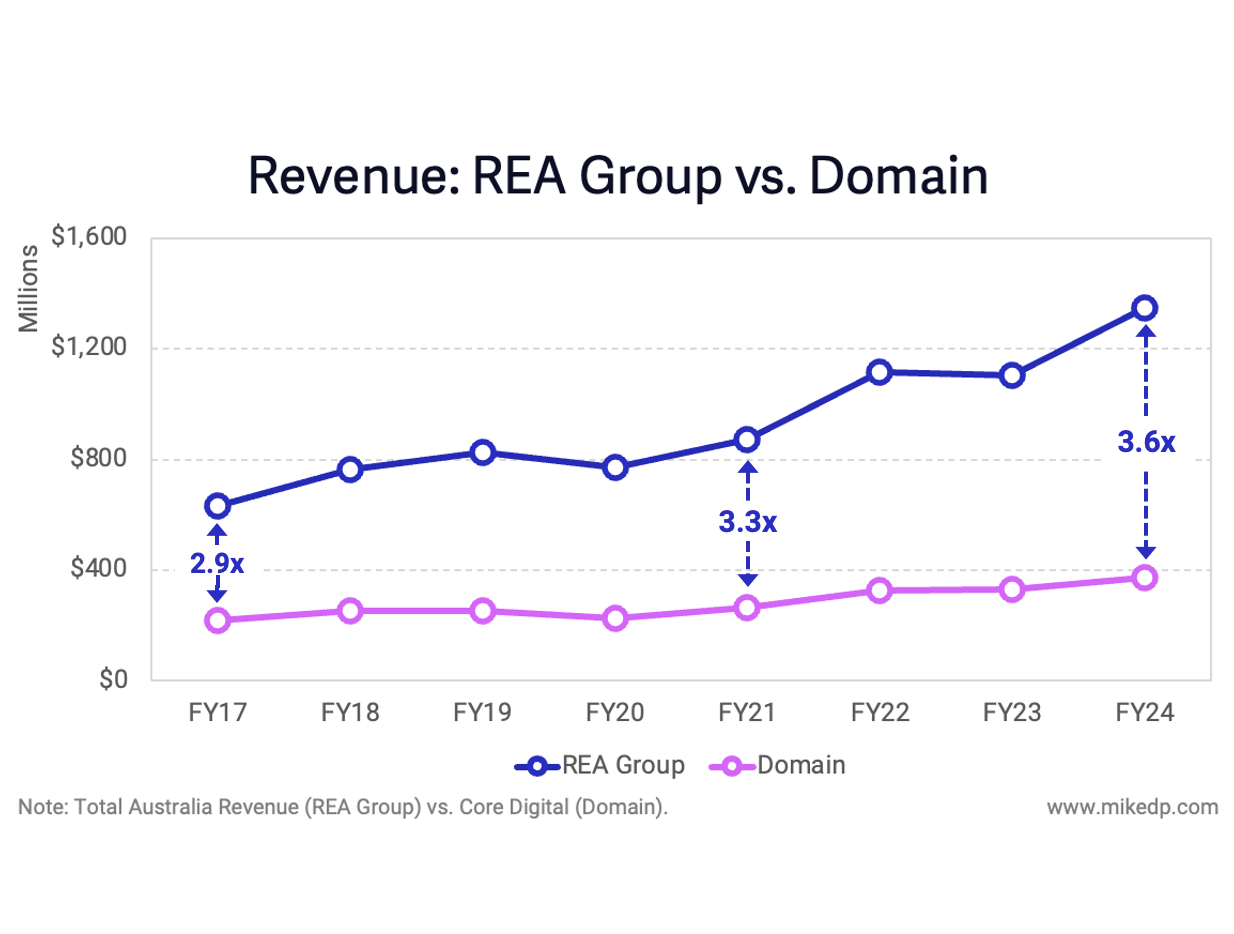
Why it matters: To set expectations, it’s important to understand the competitive landscape – in Australia, Domain and CoStar are up against an incredibly strong competitor: REA Group.

  • Over the past eight years, REA Group has maintained and expanded a commanding revenue lead over Domain: $1.3 billion vs. $374 million AUD in FY24.


For portals around the world, revenue growth comes from traffic dominance; more consumer eyeballs leads to higher advertising fees.


REA Group’s traffic lead is tightly correlated to its revenue lead; as traffic goes up, revenue soon follows. 


Interestingly, both portals have managed to increase prices, or yield, at similar rates over time.

  • For the Australian portals, yield is measured as the average revenue per listing (home sellers pay their own portal advertising costs).
     

  • REA Group has increased its yield an average of 15 percent per year over the past five years – demonstrating its incredible pricing power.


CoStar may be the larger company globally, but it is likely that REA Group will be able to bring more resources to bear locally.

  • With EBITDA of $615M and operating cash flow of $437M, compared to $123M and $392M respectively at CoStar, REA Group has deep pockets for any defensive or offensive plays.
     

  • Note: REA Group operates on an Australian financial year, a 12-month period that begins on July 1, hence the FY25 vs. FY24 comparison below. 


Competitively speaking in the U.S., it would be fair to say that CoStar’s Homes.com has had no discernible impact on Zillow’s business.

  • My research has shown that portal traffic is a non-zero-sum game, meaning traffic gained by one portal does not come at the expense of other portals.
     

  • And the same appears to be true regarding revenue: Zillow has maintained a 20x revenue lead over Homes.com for the past 18 months.


The bottom line: Australia is the third market where CoStar has acquired a residential real estate portal – and like the others, it claims to be going for the #1 spot.

  • REA Group is one of the strongest portals in the world, measured financially (cash flow) and competitively (traffic and revenue lead).
     

  • It’s unlikely that CoStar and Domain will seriously challenge REA Group’s dominance, but that doesn’t mean Domain can’t be run (and grown) as a solid, profitable business in its own right.

Research Study: What Agents Really Want in a Brokerage


Agents are at the center of the real estate transaction, and this new research study dives into what they value most in a brokerage – and the top reasons they make a move.

Why it matters: The success of a real estate brokerage hinges on its ability to recruit and retain agents, so it’s natural that they should understand the practical and emotional drivers that cause an agent to switch brokerage.

  • The research uncovered that while financial considerations and technology are important, emotional alignment, leadership accessibility, and a strong sense of belonging are the true differentiators that drive loyalty and satisfaction.
     

  • This is the most common language used by agents for what they want in their brokerage:


Agent transitions follow predictable patterns that are driven by a combination of practical and emotional drivers.

  • Agents moving from large to small brokerages often seek greater autonomy, personal connection, and mentorship. 
     

  • Conversely, those moving from small to large are looking for polish, brand recognition, and operational efficiency – but they don’t always find belonging.
     

  • A key phrase that resonated – and sums up the best of both worlds – is, “big enough to back you, small enough to know you.”

Having great technology (and strong financial incentives) are table stakes; what agents really look for in a brokerage are the softer, emotional factors.

  • Agents value training, support, and mentorship, all while feeling like “a little family” – something that can be difficult to provide as a brokerage grows in size.

A lack of support and tech overload are some of the biggest pain points for agents.

  • Technology is a double-edged sword: agents want the newest tools, but only if it’s seamless and easy to use.
     

  • Agents said things like “KW Command felt like a full-time job” and “I might have only communicated with my broker 10 times in 13 years” – highlighting the challenges brokerages can face around technology and support.

The bottom line: This research suggests that agents use a combination of practical and emotional factors when choosing a brokerage.

  • And while both are important, there may be a bigger gap (and opportunity) when it comes to the emotional factors; it’s not all about the split.
     

  • The ideal brokerage combines boutique-style warmth with enterprise-level polish, a best of both worlds value proposition that is easier said than done, and that becomes more difficult at scale.


I collaborated with my friends Eric and Sean on this research. If you want to dig deeper, they recorded an hour-long podcast digging into the results of the research project.


Research methodology: A total of 10 in-depth interviews were conducted in June 2025 with real estate agents who have spent at least five years in the industry and recently left a brokerage (within the last six months), with annual sales ranging from $3.5M–$35M.

  • Interviews were distributed across U.S. census regions: South, West, Northeast, and Midwest.
     

  • The interviews, conducted via Zoom, lasted approximately 40 minutes each.

Brokerage Growth Dominated by New Models


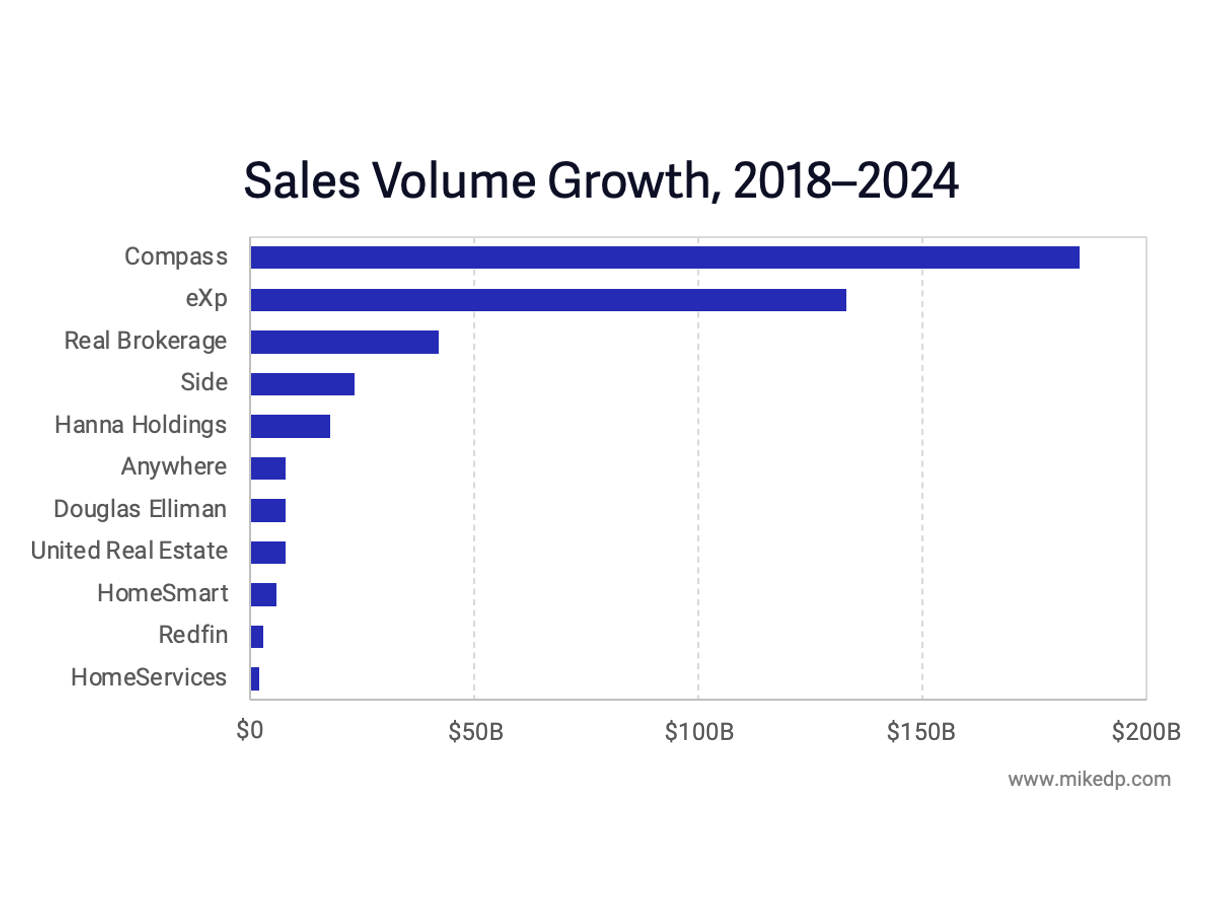
The fastest growing real estate brokerages of the past seven years – representing over $383 billion in sales volume growth – are new companies with new models.

Why it matters: While the job of an agent hasn’t changed much, the business models of the fastest growing brokerages have undergone a transformation.

  • The biggest gainers – Compass, eXp, Real, and Side – are all new models that barely registered back in 2018, but account for over $383 billion in new sales volume growth.
     

  • The biggest incumbents of 2018, Anywhere and HomeServices of America, only grew their sales volume by $10 billion during the same time period.


The growth of the new models has been stunning compared to the large, traditional incumbents.

  • In 2018, Anywhere was nearly 9 times as big as eXp – now that lead has shrunk to only 1.2 times larger.
     

  • In 2018, HomeServices of America was three times the size of Compass – now Compass is 1.7 times larger.


As a percentage, sales volume at three brokerages grew less than the increase in average sales price of a home during the same period of time: Anywhere, HomeServices of America, and Redfin.

  • This is a reflection of declining market share at these businesses since 2018.
     

  • And Redfin has faced its own series of challenges (for a deeper dive, check out my recent podcast episode on that topic).


Which brings us to today (or at least the end of 2024), with the top 11 brokerages a wild mix of traditional incumbents and new models.

  • The list includes luxury brands, 100% commission models, 100-year-old brands, portal hybrids, cloud brokers, and more.
     

  • The source of this data (and a lot more) is RealTrends.


The bottom line: It’s difficult to tell if the industry is changing quickly or slowly, but zoom out and it’s clear that a range of new models are growing extremely fast, while the traditional incumbents remain large, but are lagging.

  • It’s not one size fits all and there is no “winning model.” Yet.
     

  • But every brokerage in this list, regardless of business model, shares one important factor: at the center of every deal, every sale, and every transaction is an agent.


Thanks to Mark McLaughlin for the discussion that led to this analysis!

Zillow’s Opening Moves in the Exclusive Inventory Battle


As the deadline for compliance to its new Listing Access Standards approaches, Zillow has started to execute its strategy to stop the proliferation of exclusive inventory. 

Why it matters: The opening moves in the battle over exclusive inventory will affect the nation’s largest brokerages, thousands of listings (and thousands of homesellers), and shape the industry’s power dynamics for the next decade.

First up: Zillow has clarified its definition of public marketing to include any buyer-oriented marketing that private listings exist.

  • This is broad treatment: it’s not just a specific listing being marketed publicly (yard sign, social media post, email) that is in violation, but the mere existence of a private listing.
     

  • So, in the case of Compass, simply advertising that there are private listings on its search results page means all of those listings are in violation and subject to a potential Zillow ban.


Setting policy and issuing statements will only get you so far – to be truly effective, Zillow needs to reach out to every single agent that is in violation of its policy.

  • To change behavior, agents need to hear the consequences of listing privately directly from Zillow, not their own brokerage.
     

  • To that end, Zillow has begun calling agents with a listing in violation of its policy – example below.


Zillow then follows up with an email that outlines its policies and clarifies that after June 30, non-compliant listings will be banned from Zillow for the life of the listing agreement.


Zillow has been described to me as “ruthless” – a characterization with negative connotations which may be unfair. 

  • Instead, what I see is “maximum effort” (or “concentration of force” if you’ve sat through my Pacific War analogy at a Hub event).
     

  • There are no half-measures nor compromises; if Zillow believes in something, it’s all in, and applies the maximum effort to achieve its goals. 

Where the rubber hits the road is a single metric: the number of Compass exclusive listings.

  • Since July 2024 this has increased from 3,000 to nearly 10,000 listings, a number which, given Compass’s intentions, Zillow would prefer to be closer to zero. 
     

  • If Zillow’s strategy works this number will go down; the plateau over the past two months is likely due to seasonality. Keep in mind: Zillow just started calling agents.


The bottom line: Personal opinions aside, these exclusive inventory POWER MOVES are a masterclass in strategy, focus, and execution.

  • Over the preceding nine months, Compass has demonstrated the power of disciplined focus and strong execution, and now Zillow is countering with its own “maximum effort.”
     

  • The stakes for the industry are huge and we're still in the beginning stages of this battle.

The Top 20% of Agents Do 65% of Transactions

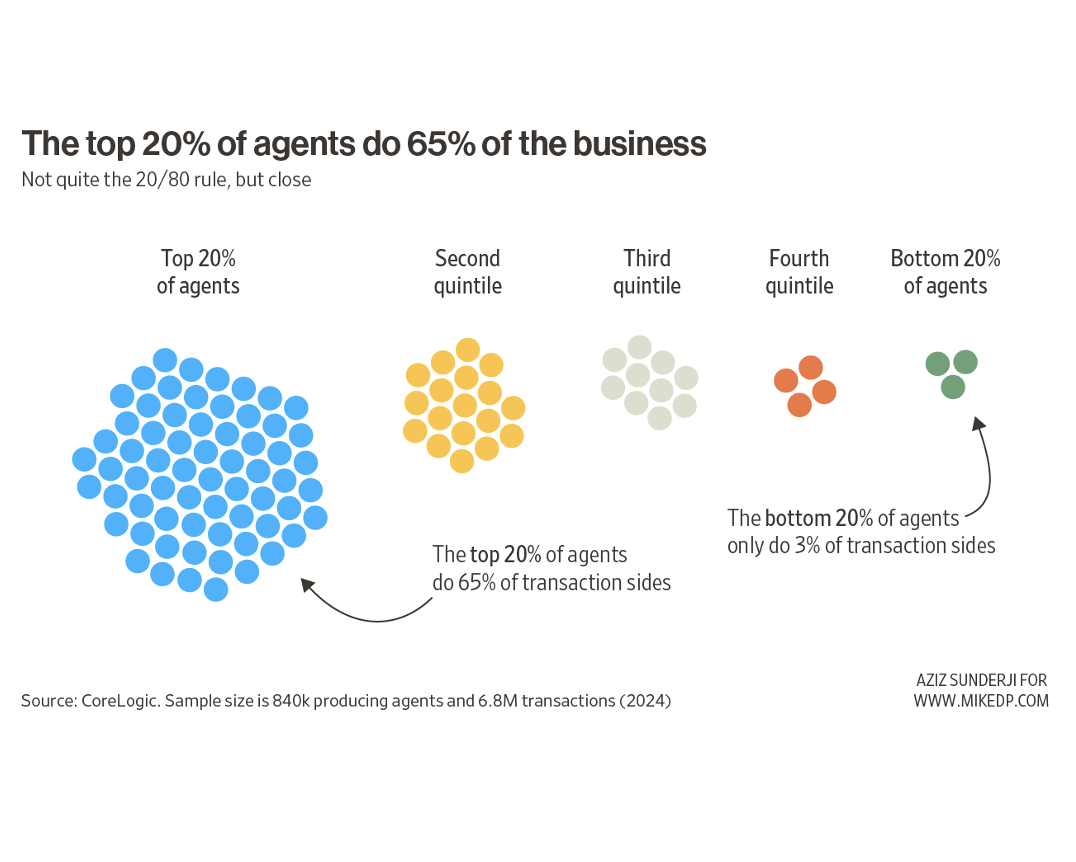
There is a commonly held belief that in real estate, the top 20 percent of agents do 80 percent of the deals – a ratio that is close, but not entirely accurate. 

Why it matters: The truth is that the industry is concentrated, but not that concentrated – the top 20 percent of agents do 65 percent of deals – leaving a very long tail of producing agents.

  • Like my previous research, this data is provided by CoreLogic/Cotality, covering 85 percent of the market: 3.4 million sales and 840,000 producing agents in 2024. 
     

  • And a shoutout to my friend Aziz Sunderji who I collaborated with on these fantastic visualizations.

Agent productivity is heavily weighted on each end of the spectrum: a small number of high-producers and a lot of low-producers.

  • The top 1 percent of agents, which also includes high-production teams, do an astonishing 18 percent of deals.
     

  • In a team, deal attribution usually falls to one agent, which makes it impossible to differentiate between individual agents and teams in the data.

Agent productivity varies wildly between these groups; a simple “average” doesn’t tell the whole story.

  • Highly productive agents and teams (the top 20 percent) are averaging 26 transactions per year.
     

  • While the remaining 80 percent of agents are averaging just 3.5 transactions per year.


A large number of low-producing agents seems to be a truism of the U.S. real estate market.

  • Even in a down market, the number of low-producing agents isn’t changing – in fact, it’s increasing.
     

  • Despite challenging market conditions, the survivability of the low-production, part-time agent remains as strong as ever.


The bottom line: The 80/20 rule is close, but not exactly the truth, when it comes to agent productivity in the U.S. real estate market.

  • In addition to a small, elite group of high-performing agents and teams, there is an extremely long tail of low-producing, part-time agents.
     

  • The implications are significant for anyone looking to parter with agents – portals, brokerages, or tech vendors – do you go after the small number of high-producers, or target the extremely long tail?

2024 Real Estate Business Profitability Roundup


2024 was another year where a receding tide – a down market – revealed truths about business model resiliency and clues about future growth.

Why it matters: Profitability, the mother of all metrics, is a proxy for a healthy business model with product market fit, financial viability, and can generate returns for shareholders.

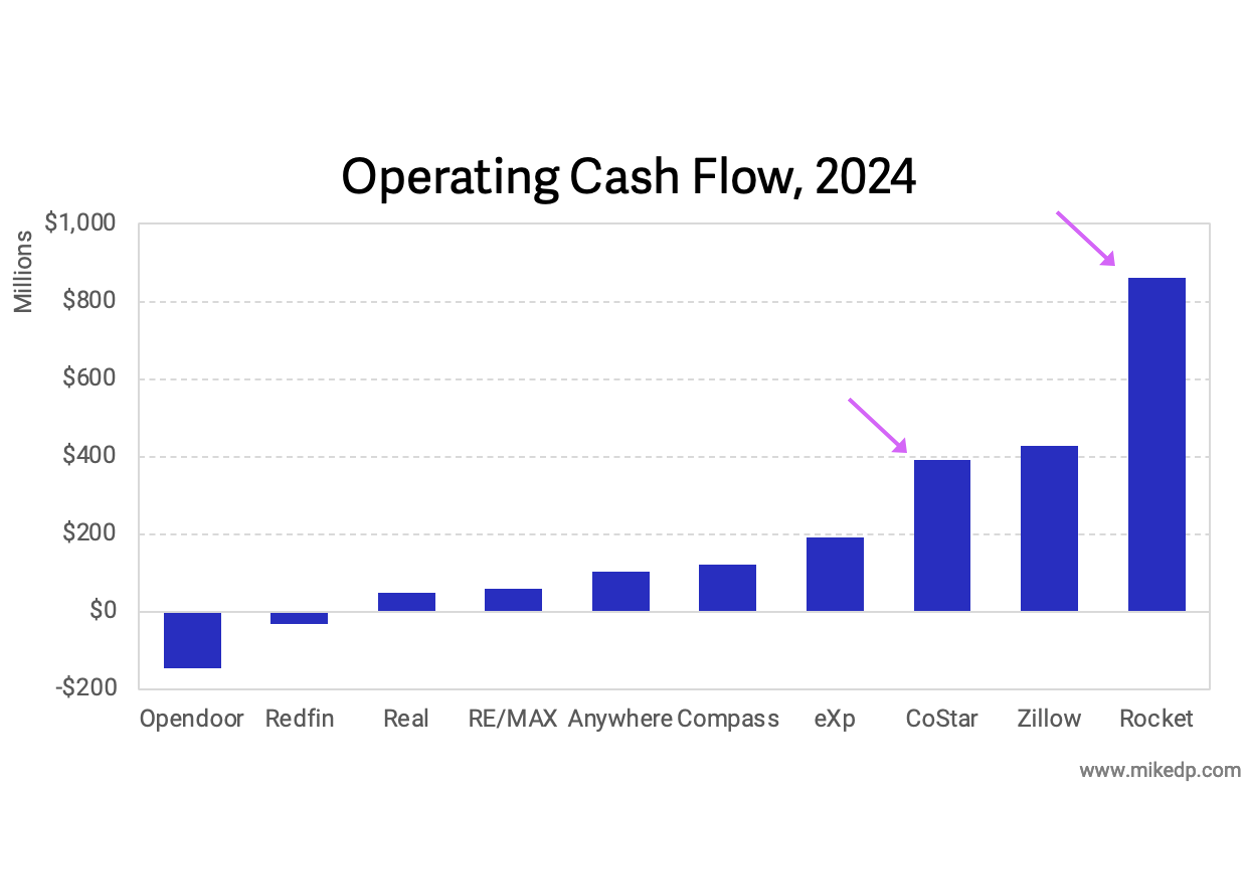
  • Starting with the brokerages, eXp Realty comes out on top as the most profitable brokerage in the United States, with almost twice the operating cash flow as Compass.


Adding top real estate portal Zillow and arch-disruptor Opendoor into the mix expands the field and shows the vast discrepancy across varied business models.

  • Zillow, with a high-margin core business, is a cash-generation powerhouse, while Opendoor continues to lose money buying and selling houses (asset-light vs. asset-heavy).
     

  • Remember when Zillow exited the iBuyer business? Smart move.


Throwing Rocket and CoStar into the mix illustrates the high-stakes game of the Portal Wars – to-date, it’s been Chess without Checkmate.

  • These companies are using profitable core businesses (mortgage and commercial real estate) to fund a massive expansion into residential real estate. 
     

  • With its $1.75 billion acquisition of Redfin, Rocket is the new entrant to watch.


CoStar’s Operating Cash Flow dropped $100 million from the previous year – the most significant (and only) decline in six years.

  • CoStar has been investing heavily in its residential real estate portal, Homes.com.
     

  • Perhaps related, CoStar recently reached an agreement with a pair of hedge funds to refresh its board, “articulate a disciplined capital allocation strategy,” and “review the Company’s ongoing investment in Homes.com and ensure an appropriate timeline for profitability.”


Opendoor’s Operating Cash Flow has been negative for several years now, which begs the question: how much money does it have in the bank?

  • The answer is about $600 million as of Dec 31, 2024.
     

  • But, perhaps worryingly, its cash balance keeps declining – it’s down by about half ($600 million) over the past two years.


What to watch: The data reveals a few areas of interest.

  • How aggressively will Rocket use its massive cash advantage to grow its presence in the portal and brokerage space?
     

  • Will there be a change in CoStar’s level of investment in Homes.com?
     

  • And, will Opendoor consider a business model pivot before its cash runway expires?

The bottom line: It may sound elementary, but a business needs to have a business model that works – and that means consistently making more money than it spends.

  • It is those businesses – generating free cash flow – that are able to invest for growth, give returns to shareholders, and use the profits to launch new ventures that add value in the real estate ecosystem.
     

  • Cash is funding significant POWER MOVES heading into the rest of the year: the exclusive inventory battle, Rocket's entry into the portal wars, and the massive investments into end-to-end ecosystems.

Zillow Strikes Back Against Exclusive Inventory


Zillow just announced a new policy: if a home is publicly listed for sale in a private network, it will never appear on Zillow.

Zillow’s new policy states that a listing marketed to ANY buyer must be available to EVERY buyer.

  • Listings must be in the MLS and published on Zillow, as well as other sites that receive MLS feeds, within 24 hours of being advertised publicly.
     

  • And listings that don’t meet these standards won’t be published on Zillow and Trulia for the life of the listing. 

Why it matters: This is a big deal and acknowledgement that exclusive inventory is a significant threat to Zillow.

For anyone closely watching and thinking a few steps ahead, this is a logical move on Zillow’s part.

  • Op-eds, opposing research, and rousing speeches haven’t stopped Compass from growing its exclusive inventory, and other brokerages following in its footsteps.
     

  • NAR is on the sidelines. And it will take years for any legal challenge to take shape. Zillow is the only player able to take action, and it is.

Power play: Zillow is flexing its considerable muscle to defend itself, stop what it sees as bad behavior, and take a strong moral stand to maintain a fully open and transparent marketplace. Finances aside, this move is aligned with Zillow’s values.

Zillow is effectively forcing agents to make a choice, but the ultimate deciding force in this battle isn’t the portal, the brokerage, or the agent – it’s the consumer.

  • And this move is precisely and strategically aimed at that critical juncture, forcing agents to explain to a home seller why their listing will never be on Zillow, the country’s most popular real estate website, if they decide to list in a private network.

For months people have been asking who could possibly stop the rise of exclusive inventory.

  • While all eyes were on NAR, the obvious answer was in plain sight: the consumer.
     

  • And Zillow’s move is aimed squarely at pulling them into the discussion.

What to watch: Quite simply, the following chart, which shows the total number of Compass Private Exclusives and Coming Soon listings.

  • Zillow's new policy begins May 1st.


The bottom line: To quote Churchill, this is only “the end of the beginning” in the battle over exclusive inventory.

  • The phase of posturing through words is over.
     

  • Now everyone in the space, from brokers to portals to agents, needs to start making some tough decisions.

The Business Case for Exclusive Inventory

Brokerages and agents have clear incentives to promote exclusive inventory, a strategy that could significantly reshape power dynamics across the industry.

Why it matters: Understanding the motivations surrounding exclusive inventory is critical to predicting the direction this battle will take – and why brokerages like Compass are pushing it so hard.

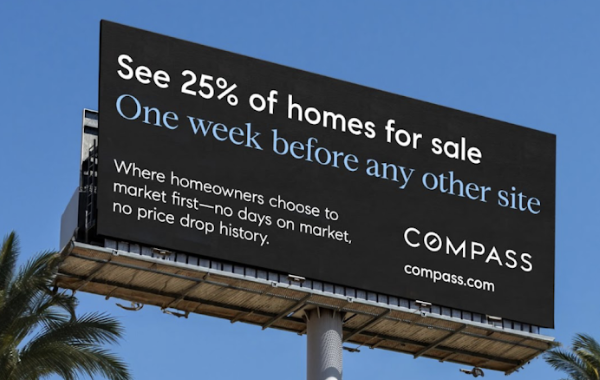
  • This billboard mockup, used by Compass to explain the exclusive inventory strategy to its agents, succinctly sums up one key benefit.

The key phrase is “one week before any other site” – exclusive inventory is not exclusive forever; a better label might be “pre-marketing.”

  • The typical Compass exclusive is off-market for 2–3 weeks, with 94 percent of these listings eventually appearing on, and selling through, the MLS.
     

  • This pre-marketing period is akin to a restaurant soft opening – that’s a test run held before the grand opening, where a select group of guests try the restaurant and provide feedback, allowing it to fine-tune operations and menu before opening to the public. 

For brokerages like Compass, providing access to exclusive listings helps to attract and retain agents, and any leads that come directly through the brokerage website could be monetized in-house rather than through a portal.

  • For agents, access to off-market listings is a very tangible way to provide and demonstrate value to potential buyers – and is a key differentiator to secure more clients.


The following chart shows the potential revenue benefit (after commissions are paid to agents) to Compass for every 100 agents recruited, closed compass.com website leads, and double-ended deals.

  • These estimates are based on the following assumptions: average sale price of $1.06M (Compass FY24), average agent production of 6.1 transactions per year (Compass FY24), average commission of 3 percent, website lead referral fee of 35 percent, and an 82 percent agent commission split (Compass FY24).
     

  • In aggregate and at scale, these benefits could be worth $50–$100 million or more in additional revenue per year.


Another financial benefit comes from using access to a large pool of exclusive inventory – a major value to agents – to gradually shift commission splits in the brokerage’s favor.

  • Compass’s average commission split is 82/18 (82 percent to the agent, 18 percent to the brokerage).
     

  • Shifting that just one percentage point would be worth $56 million to Compass while, on average, costing an agent $1,940 per year (using the same assumptions above).

For an individual agent, being able to secure two additional transactions per year (buy side or sell side) through access to exclusive inventory would, on average, yield $52k in additional income.

  • Three additional transactions would yield $78k, which, in either case, far outweighs the $1,940 an agent might give up from a one percent reduction in their commission split.
     

  • It’s really a financial win-win for agents and brokerages.


The big question: Is exclusive inventory, or a pre-marketing “soft opening,” good for consumers? Far be it for one author to make that determination for the totality of sellers in the United States.

  • At the end of the day, homesellers are choosing whether it’s good for them or not, based on their particular circumstances and the benefits of the program – and in the case of Compass, 55 percent of new listings opted in to the program in February.
     

  • Compass is not alone; behind the pro-consumer headlines, nearly everyone – from NAR to MLSs, from big and small brokerages to the portals – has a financial motivation to fight for for the expansion or contraction of exclusive inventory.

Casual, Part-Time Agents Not Going Anywhere


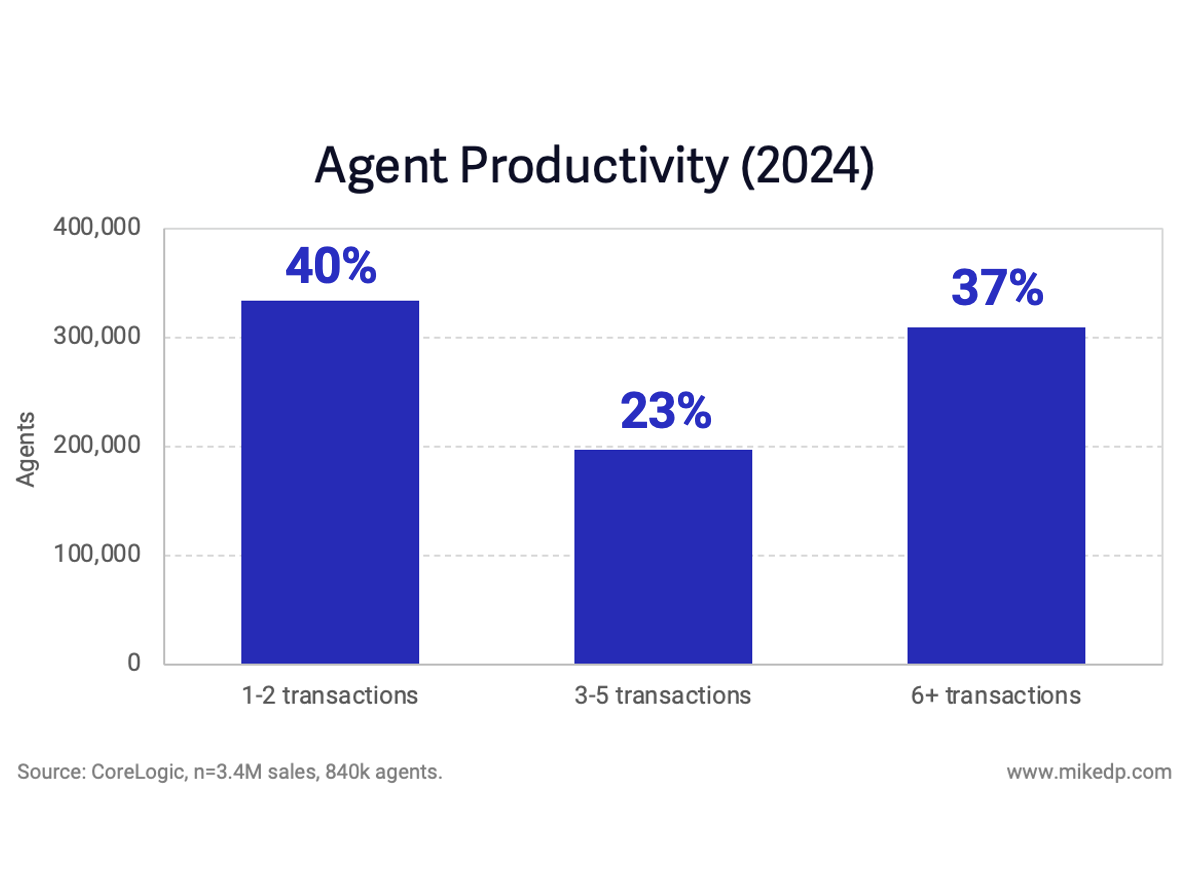
Perhaps counter-intuitively, with fewer transactions in the market there are just as many part-time, casual agents as ever – with the majority of producing agents completing less than five transactions in 2024.

Why it matters: The down market is revealing some key truths about the fragmented nature of real estate – and what happens to agent production when there are a million fewer sales to go around.

  • In 2024, the average producing agent completed 8 transactions – down from 10 in 2021.
     

  • This analysis is based on data provided by CoreLogic, with 85 percent market coverage: 3.4 million sales and 840,000 producing agents in 2024. Each sale kicks off two transactions: one buy-side and one sell-side.


The market continues to be dominated by casual, part-time agents.

  • 40 percent of producing agents only did 1–2 transactions in 2024.
     

  • If you consider a part-time agent someone who does five or fewer transactions per year, that number rises to 63 percent. 


And over time, that ratio isn’t changing – part-time agents aren’t going away.

  • Since 2021, the number of agents doing 1–2 transactions per year has increased slightly, while the number of agents doing 6+ transactions has dropped considerably.
     

  • There are significantly fewer sales in the market which is disproportionately affecting higher-producing agents; the evidence doesn’t support the theory that causal agents disappear in a down market.


As I’ve said in the past, agents are like cockroaches; they’re survivors and tend to stick around.

  • Even with 25 percent fewer sales in 2024 compared to 2021, there were only 7 percent fewer producing agents.
     

  • Keep in mind this data is from the CoreLogic dataset (85 percent of the market), and does not represent the entire market.


The bottom line: Real estate remains a highly fragmented industry, with a lot of agents doing, on average, just a handful of transactions each year.

  • And with a shrinking market, there is not a corresponding decline in the number of producing agents; rather, the average number of transactions per agent is dropping.
     

  • Despite challenging market conditions, the survivability of the low-production, part-time agent remains as strong as ever.

The Redfin Experiment is Over


With its acquisition by Rocket, Redfin’s saga as an independent company is coming to a close.

Why it matters: Launched in 2002, Redfin could be considered the original real estate disruptor, featuring discounted commissions, employed agents, and innovative technology – but the business model just never clicked.

  • Redfin was rarely profitable, accumulated a large debt load, and was acquired for the same value as when it went public over seven years ago.

After its first day of trading as a public company in 2017, Redfin was valued at $1.73 billion – just shy of its acquisition price of $1.75 billion seven years later.

  • Yes, but: After Redfin’s first day of trading in 2017 each share was valued at $21.72, significantly higher than Rocket’s acquisition offer of $12.50 per share.
     

  • If you owned $100 of Redfin shares in 2017, they would be worth $58 today – a decline of 42 percent (due to dilution – it’s a thing!).


Redfin was never really profitable: Operating Cash flow, which measures how much cash the business generates, is a good corollary for profitability.

  • Since its IPO, Redfin had two profitable years vs. five unprofitable ones, for a combined loss of $368 million (again, this is actual cash flow and not “net loss” which includes non-cash expenses like stock-based compensation).
     

  • Redfin innovated in so many areas, from agent compensation to groundbreaking tech products, but at the end of the day it just didn’t make money.


Not only is Redfin consistently unprofitable, but it has a high debt load – $815 million – with steadily dwindling cash reserves of just $125 million at the end of 2024.

  • Much of that debt, totaling over $1.2 billion by the end of 2021, was used to fund a pair of expensive acquisitions.
     

  • Redfin acquired Rentpath for $608 million in 2021, and Bay Equity Home Loans for $138 million in 2022.


It’s fair to say the acquisitions didn’t pan out as expected.

  • Redfin recently announced a deal that effectively outsourced its rentals business to Zillow for $100 million.
     

  • And in contrast to Zillow’s growing mortgage business, Redfin had to cut costs; its mortgage headcount declined from over 450 mortgage loan officers in 2023 to 275 in March 2025.


Real estate disruptors have a tendency to “go native” and, over time, end up looking more and more like the companies they were originally trying to disrupt.

The bottom line: Back in 2023 I said, “...it appears that Redfin is overstretched with limited resources and up against well-funded competitors…this is a galvanizing moment for the business; one way or another, something has to change.” Well, something did.

  • Redfin tried to do a lot: web portal, brokerage, iBuying, mortgage, rentals, title insurance, and more – with just one of those categories being more than enough to occupy a company full time.
     

  • In the end, it might be that lack of disciplined focus that prevented Redfin’s success – plus a lack of resource and scale – which the company now has after its acquisition by Rocket.

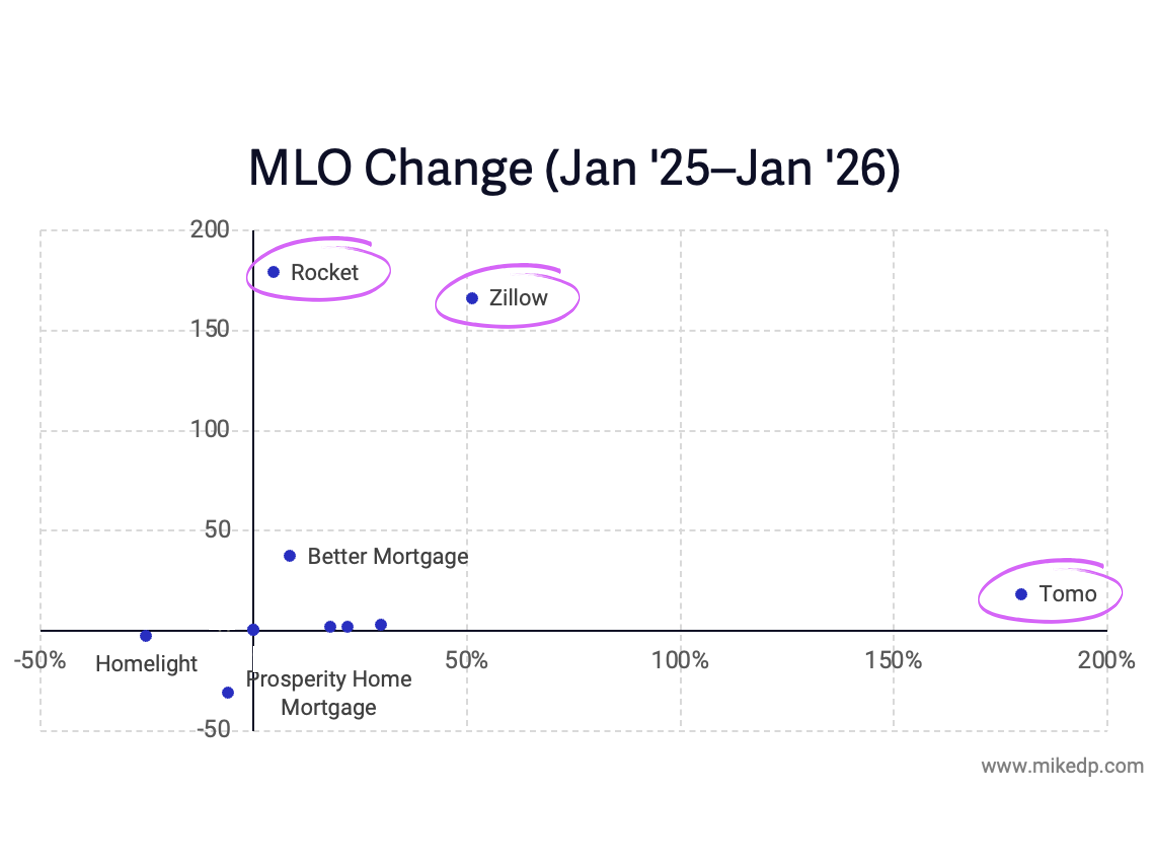
Rocket Enters The Portal Wars


With a Super Bowl ad followed by the $1.75 billion acquisition of Redfin, Rocket has emerged as a serious player in the U.S. real estate portal space.

Why it matters: Rocket is going down a similar path as Zillow, in search of, as I said in the Wall Street Journal, the holy grail of real estate: a one-stop shop that combines home search, buy & sell, financing, and title insurance.

  • Zillow and Rocket are approaching the same goal from different directions; Zillow with top of the funnel traffic and a large agent network, and Rocket with tons of loan officers and consumer marketing.


These are titans of the industry – which, including CoStar, are the companies with the highest operating cash flow (profit) in real estate. 

  • Cash flow = investment potential. These companies can afford to invest more, at a scale higher than anyone else, in innovation, disruption, and guiding consumer behavior.
     

  • The chart below also makes it clear why Redfin could no longer compete against this collection of profitable behemoths.


The annual advertising budgets of these companies are massive; CoStar and Rocket are approaching $1 billion each.

  • This is a reflection of the firepower available to try and move the needle in consumer behavior; not just to build awareness, but to promote the one-stop shop of a seamless real estate transaction.
     

  • CoStar and Rocket’s advertising budgets are for the entire company, not just the residential portals, but remain a good reflection of the resources available.


Rocket's entry into the space raises an interesting question about, at a category level, who's disrupting whom.

The bottom line: The total addressable market for a one-stop shop experience is absolutely massive; there is more than enough room for many players to be successful.

  • It’s like the explorers Magellan and Vasco de Gama – just because one is successful doesn’t mean the other can’t succeed, too – and there’s more than one path to success.
     

  • While it remains uncertain if a consumer will specifically seek out a one-stop shop solution, it does mean that the more opportunities the portals capture at the top of the funnel, the less opportunities there will be for everyone else.

The Exclusive Inventory Power Play


While the public debate swirls around NAR’s Clear Cooperation Policy, behind the scenes Compass has steadily built up an exclusive inventory of over 7,700 listings.

Why it matters: Exclusive inventory represents a way for agents and brokerages to exert more control over their listings, and has the potential to materially shift existing power dynamics across the industry.

  • Compass has more than doubled the number of its Private Exclusive listings over the past seven months – up from 2,500 in July 2024 to over 6,000 in February 2025.
     

  • Private exclusive listings (as opposed to Coming Soon) are not publicly advertised; a consumer needs to connect with a Compass agent for access.


Private Exclusives account for roughly 30 percent of all Compass listings; including another 1,400 Coming Soon listings brings that to 35 percent.

  • Underlying this push is Compass’s 3-Phased Marketing Strategy, which encourages homeowners to start with a Private Exclusive before listing on the MLS.
     

  • And it appears to be resonating with agents and consumers: so far, 55 percent of all new listings in February started as a Private Exclusive or Coming Soon. 


There are broad implications to the rise of exclusive inventory – interestingly reminiscent of the evolution of video streaming.

  • There was a time when Netflix, containing nearly all streaming content, was the only game in town – but more recently, other content creators, like Disney and Apple, have launched their own streaming platforms.
     

  • On the one hand, it’s more time-consuming and expensive for consumers to visit and pay multiple services to get what they want; the one-stop-shop marketplace is gone.
     

  • But on the other hand, consumers now have a choice, and that has spurred platform innovation and billions of dollars in content creation.

Yes, but: video streaming is not real estate, I get it, but it’s an interesting thought experiment.

  • Exclusive inventory is the norm overseas: in Australia, #2 portal Domain has advertised exclusive content (or at least a first look at exclusive content).

Dig deeper: In 2021 I wrote about exclusive content being the Top Threat to Real Estate Portals.

The bottom line: There’s a lot of talk on conference stages and op-eds, but Compass has focused on action by steadily building up a large supply of exclusive inventory.

  • Exclusive content has the potential to materially shift existing power dynamics across the industry – it challenges the fundamental assumptions of an open marketplace, but also sets the stage for further innovation.
     

  • Regardless of which side you’re on, the rise of exclusive content is inarguably an industry needle-mover, and things are about to get really interesting.


Note: The data in this article is all publicly available on Compass.com. I’d like to thank Max Mitchell and my friends at Supergood for their help with the data collection.